

Get Out of Reactive Mode!
Don’t let your calendar dictate your focus

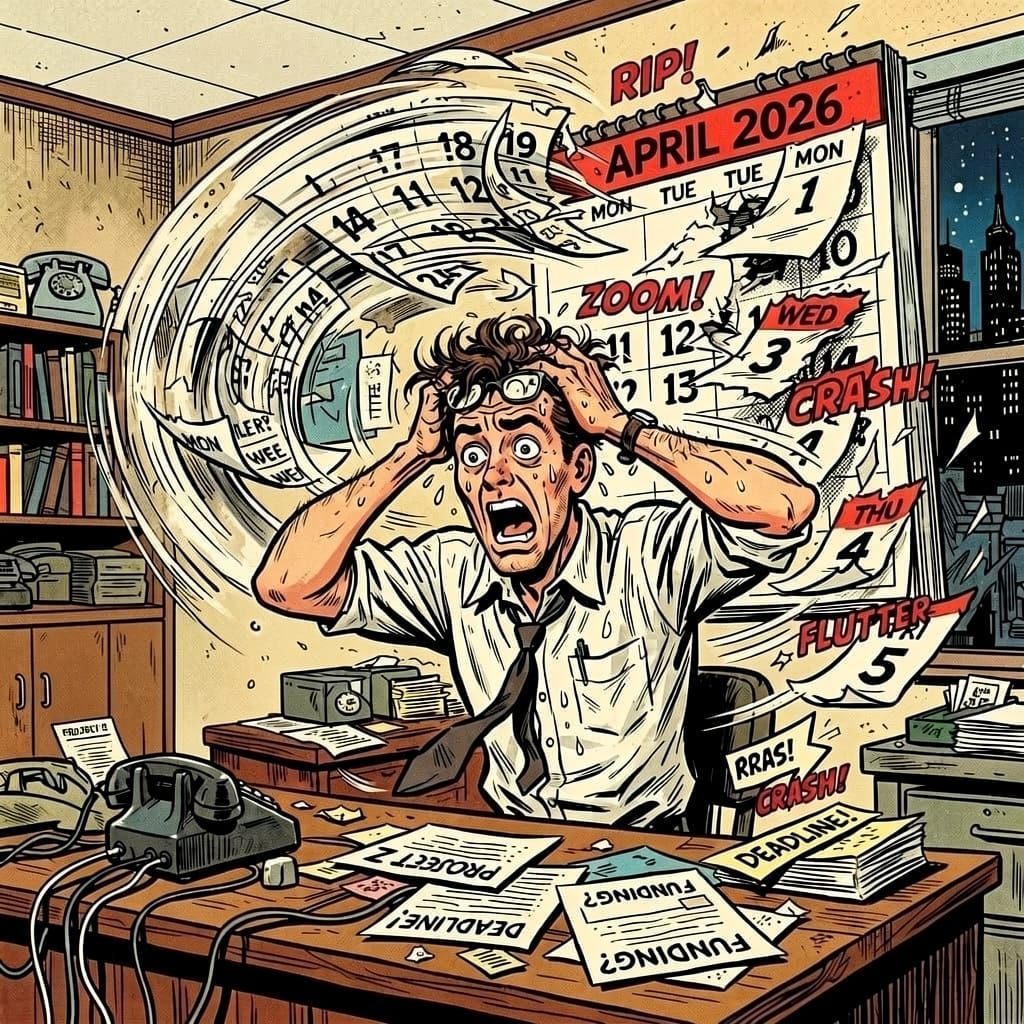
If you’ve ever spent a week in back-to-back meetings and then wondered where the time went, that’s a sign you’re stuck in reactive mode. It’s one of the things I’ve seen founders struggle with most: figuring out their own role once the company gets past the initial crush of building and launching their product. Typically they’ve hired a growing team of executives, and now no longer need to fight every fire, drive every action, or make every decision. So if you’re not supposed to be in reactive mode anymore, what are you supposed to be doing?
This is when founders need to take a step back and look at the longer horizon, beyond the next deal, the next hire, the next sprint. Good leaders move from reactive mode to proactive to guide the company’s growth and strategy. You are looking for opportunities, improving collaboration and unblocking bottlenecks so that the organization can grow.
An important element of managing this transition is to re-assert control over your calendar. If you don’t manage your calendar, it will manage you. There are an infinite number of ways to do this. You can use any system you like, but you must have one.
Over several decades, I have tried various approaches to time management, often based around GTD - Getting Things Done. While my system isn’t perfect, it works for me and perhaps it will inspire the development of your own time management system.
The Four Quadrant System
Every Monday morning, I draw a cross in my notebook to create 4 quadrants. At the top I write the date. In the upper left quadrant, I list all the meetings scheduled for the week. This includes staff meetings, departmental reviews, one-on-one meetings, board meetings, etc. These are commitments that have to happen. Depending on the week, this is usually 6-10 meetings. There are no “optional” meetings. I’m either committed or I’m not attending. I don’t do a lot of “skip-level” meetings, that is , with people who do not report to me directly. And I definitely don’t take such meetings on a recurring basis, since I don’t want to blur formal reporting lines.
I may not love every meeting I’m in, but I enjoying checking them off as they occur. I enjoy checking things off so much, that sometimes when unplanned work occurs, I write it down and check it off immediately. Call me weird, but it works for me.
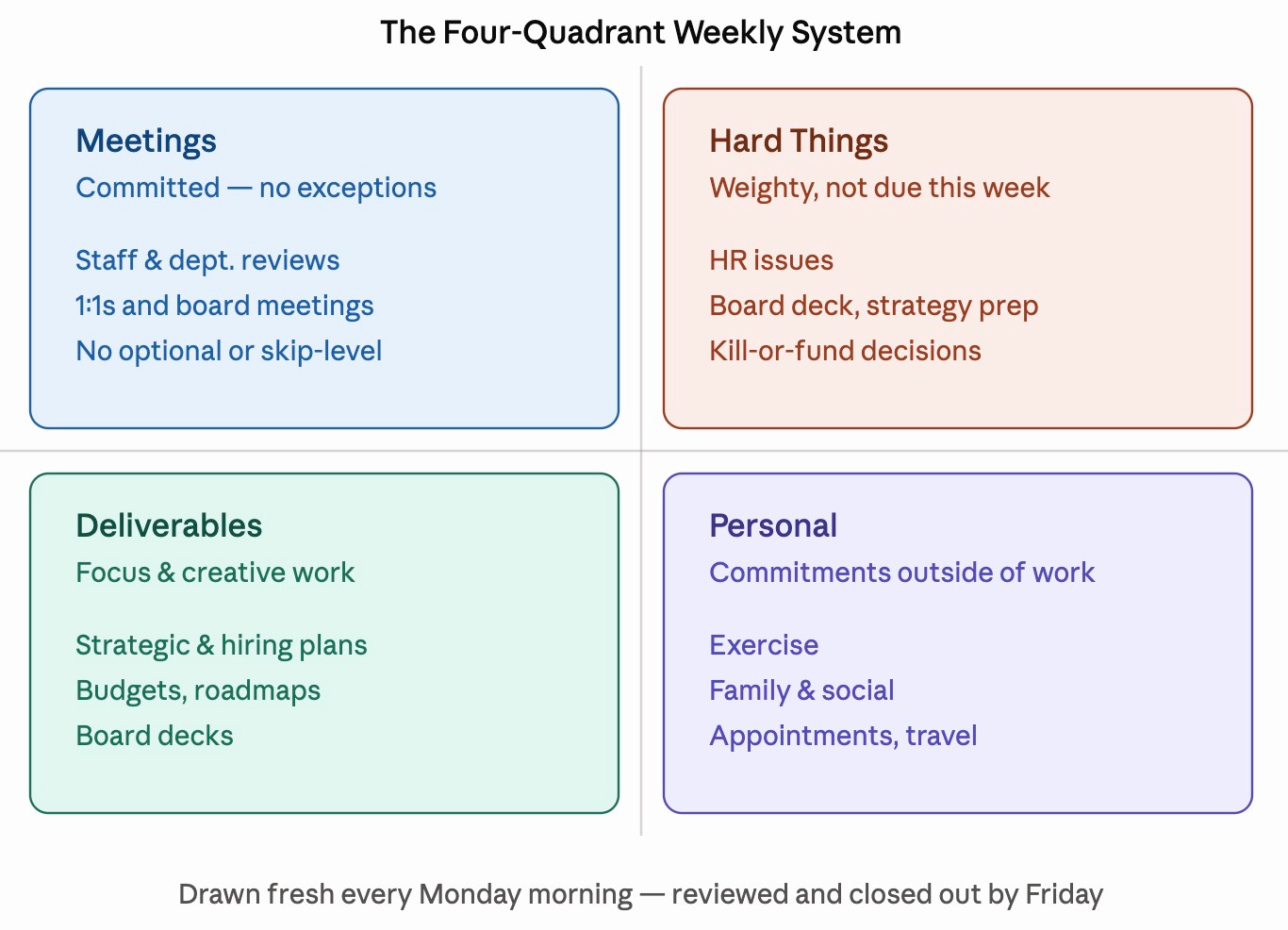
In the lower left quadrant, I list specific deliverables I need to get done. This might include strategic plans, hiring plans, budgets, product launch plans, pipeline or roadmap reviews, board decks, etc. Depending on what is going on this list might range from 4 to 6 items. Often these are areas of intense focus, creative work, or both. I don’t generally block out my calendar to work on these items, but that’s a legitimate way to operate if other people are adding things to your calendar.
In the upper right quadrant I write the hard things I need to deal with that are not deliverables due this week. Generally this is a short list of 3-5 items. They are weighty items, but usually there are not that many. The list might include preparing an upcoming board deck, a strategic plan, making an offer to hire someone, terminating someone, selecting a banker, deciding to kill a project or any number of complicated decisions. Not every item in this list will get completed in a single week, but I try not let things carry over more than a couple of weeks.
In the lower right quadrant, I write whatever personal items I need to take care of. This is generally a small list of 4-6 items. It will always include exercise (running, cycling, going to the gym), personal obligations (dentist visits, taking my car in for service, booking future travel) and social obligations. For things that are personally important, like running, I always find the time, even if it’s at 7am.
This four quadrant system lets me see the week in advance and ensures I have a fresh view of what’s important every week. It also gives me a sense of control over the week. Before the chaos starts in, I know what needs to happen. This helps me dedicate time to harder, long-term tasks and not let my week get jammed with low-priority items. If we are behind on sales pipeline, I’m going to make sure I spend time on that issue. By writing it down, I ensure it gets attention.
Don’t Kick The Can
I typically review the quadrant throughout the week. I love checking things off, even if it’s just a meeting that occurred. That also forces me to see the high-priority items that are still awaiting action. As the week proceeds, there is usually a sense of progress. The hard stuff is getting worked on.
Usually late on Thursday, or at worst, Friday morning, I look to see what has not yet been completed. Then I make sure as many of the critical items get done as possible. I’m not one to kick the can down the road week to week. I make sure the hard things get done, if only so I can check it off my list and be done with it. Even if it’s a tough decision or difficult action like terminating someone, having written it down, I know it will get done.
Meeting Notes
In advance of any given meeting, I will allocate a separate page for notes. This includes my advance preparation such as defining the agenda if it’s a meeting I’m running. Or even notes to remind me of critical ideas that need to be discussed, hard questions, or just reminding me to listen, be gracious or thankful. I typically write action items on those detail pages, rather than on the weekly quadrant. This includes my own action items or my expectations for others. If there are action items I want to be clear who has them and when they are due.
I hate being a bottleneck to others, so when I review the quadrant late in the week, I also review notes from meetings to make sure my action items are getting done. If necessary, I will follow up with others to make sure there’s no confusion about decisions or action items and nothing got lost.
Build Your Own System
While my system is not foolproof, it works well for me. It brings focus to my week as well as a sense of progress. I see that decisions are made, actions are taken, follow up is clear. It’s exceedingly rare that something falls through the cracks.
This system didn’t come to me fully formed. I learned it from a mentor and former boss, Del Yocam, who had been President and COO of Apple in its early days. Del carried a notebook everywhere and wrote down everything that needed to get done. I’ve tried plenty of software tools over the years, but for me, nothing beats the simple act of writing things down and checking them off.
You don’t need my system. You need your own. But whatever you build, the goal is the same: make sure your attention reflects your priorities, not everyone else’s.

Mentor and Borland CEO Del Yocam and me outside the Kremlin in the late 1990s.
Delphi was widely adopted in Russia thanks to a liberal country-wide site license.
Great simple system. No amount of apps or AI will replace pen on paper.